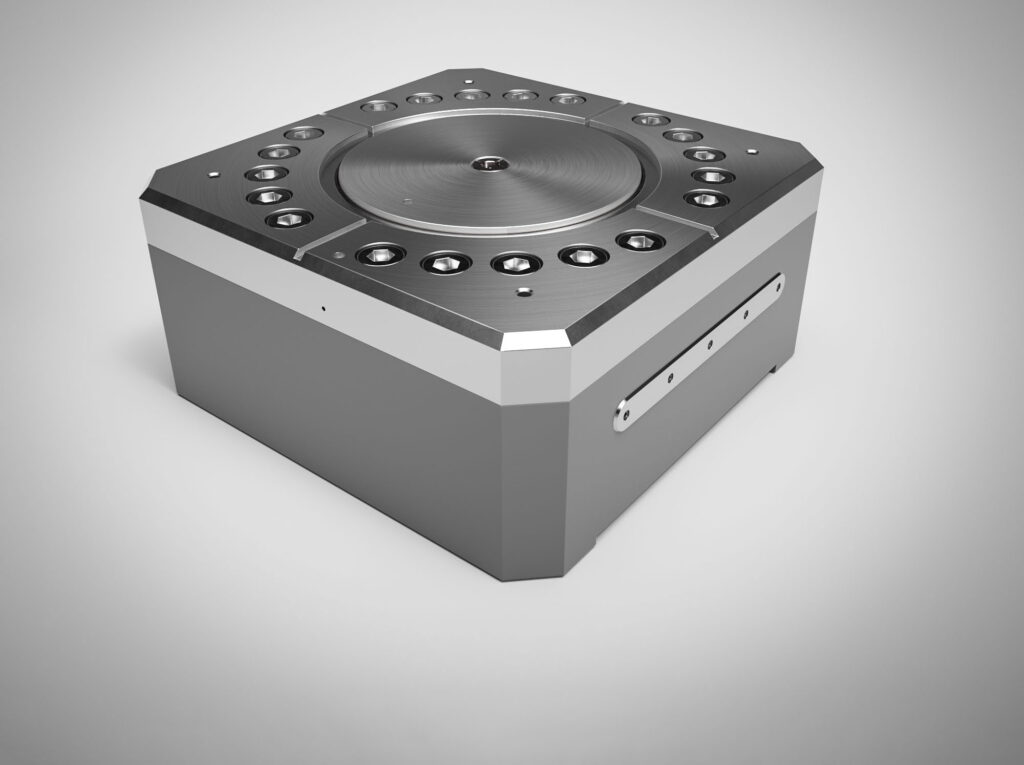
About actuating cylinders
Actuating cylinders are specialized hydraulic components used in a wide variety of industrial applications, including rolling mills, to generate precise movements and forces. They play a crucial role in many areas of mechanical engineering, particularly in metal processing. A prime example of their application is roll gap control in hot and cold rolling mills.
Functioning of actuating hydraulic cylinders
Adjustment cylinders consist of a cylinder housing, a piston, and a piston rod, and are a type of hydraulic cylinder. Their movement enables precise control and positioning, which is particularly important in applications requiring accurate motion control. Adjustment cylinders are frequently used in rolling mills to set the rolling force and the distance between the work rolls, and they can respond to rapid load changes.
Advantages of actuating cylinders
- High precision: Actuating cylinders offer high accuracy in positioning, making them ideal for applications where precise movements are required.
- Power transmission: They are able to transmit large forces and efficiently regulate the force within the hydraulic cylinder, making them particularly useful for heavy industrial applications.
- Versatility: Actuating cylinders can be used in a wide variety of environments and applications, from metalworking to automation technology.
- Durability: Thanks to the use of high-quality materials and construction techniques, actuator cylinders are durable and require little maintenance.
Actuating cylinder in the roll gap control
Roll gap control is a critical process in metal processing, particularly in hot and cold rolling mills. The precision and efficiency of this process depend significantly on the ability to accurately control the distance between the rolls. This is where adjusting cylinders come into play, regulating the rolling force and enabling precise and rapid adaptation to different operating modes.
Hot rolling mills in the rolling mill
In hot rolling mills, metal is processed at high temperatures, requiring precise control of the roll gap to achieve the desired material thickness and quality. The diameter of the piston and piston rod in the adjusting cylinder plays a crucial role in adapting and controlling the rolling mill processes. Adjusting cylinders are used to continuously adjust the roll gap, ensuring that the metal is rolled uniformly and precisely. This is particularly important to prevent material defects and guarantee the consistency of the final product. Adjusting cylinders are used in various configurations, including vertical straightening machines.
Cold rolling mills
In cold rolling mills, the metal is processed at room temperature. The technical specifications of the repaired hydraulic cylinder include a weight of 7,000 kg. Precision requirements are even higher here, as the process is more sensitive to fluctuations in the roll gap. Adjusting cylinders enable precise control of the roll gap, resulting in improved surface quality and material properties. The ability to precisely control the roll gap is crucial for achieving the desired mechanical properties of the metal.
Specific advantages of adjusting cylinders for roll gap control
- Improved product quality: Precise control of the roll gap allows adjusting cylinders to contribute to improving the quality of the rolled metal. This results in a better surface finish and consistent material properties that meet high technical standards.
- Reduced scrap: Precise roll gap control minimizes material defects and deviations, resulting in less scrap and rework.
- Efficiency improvement: Automating the roll gap control through the use of adjusting cylinders can accelerate the production process and increase efficiency.
- Cost savings: By reducing material waste and rework, as well as improving production efficiency, adjusting cylinders can contribute to significant cost savings.
Selection and implementation of actuator cylinders
Several factors must be considered when selecting actuating cylinders for roll gap control:
- Force requirements: The cylinders must be capable of providing the forces required for roll gap control. Technical specifications and data such as weight, piston diameter, and piston rod diameter are crucial for selection.
- Stroke and speed: The length of the stroke and the speed at which the cylinder operates must meet the requirements of the specific process.
- Materials and construction: The materials and construction of the cylinder should be tailored to the operating conditions to ensure a long service life and reliability.
- Control system: Integration into the existing control system of the rolling mill is crucial for the efficient and precise control of the roll gap.
Maintenance and servicing
Regular maintenance and servicing of actuator cylinders is crucial for their long-term performance. This includes checking seals and sealing rings for wear, ensuring adequate lubrication, and checking the hydraulic fluid for contaminants. An aluminum cover can help protect the cylinders from external influences. In addition to maintaining performance, regular inspection and maintenance also help minimize downtime and extend the service life of the cylinders.
Future developments
As technology advances, the application areas and efficiency of positioning cylinders continue to improve. Future developments could include the use of intelligent control systems and sensors, enabling even more precise and efficient roll gap control. These developments relate, among other things, to vertical positioning cylinders for long, rapid stroke movements in rolling stands, including vertical upsetting stands. Furthermore, new materials and construction techniques could further enhance the performance and durability of the cylinders.
Benefits for the customer summarized
Positioning cylinders offer numerous advantages to customers in modern metal processing, particularly in roll gap control in hot and cold rolling mills. Their ability to generate precise movements and forces enables a significant improvement in product quality. Customers benefit from reduced scrap and increased production efficiency, resulting in lower costs and higher profitability. Adaptability to specific requirements and regular maintenance ensure a reliable and cost-effective solution for industrial applications. Thanks to advancing technologies and innovative methods, the application possibilities and performance of positioning cylinders are continuously expanding, providing customers with a future-proof investment in their production processes.